Adoption timelines in Florida vary significantly depending on the type of adoption you’re pursuing and the specific circumstances of your case. Some families complete the process in under a year, while others wait much longer.
We at Juliana Gaita, P.A. help families understand what to expect at each stage. This guide breaks down realistic timelines for domestic and international adoption so you can plan accordingly.
What Slows Down or Speeds Up Your Adoption Timeline
How Adoption Type Shapes Your Timeline
The type of adoption you pursue shapes your timeline more than anything else. Domestic infant adoption through an entity like an agency typically involves a home study, matching, placement, and finalization-a process that commonly takes 1 to 5 years according to adoption industry data. Foster care adoption moves differently because the child is already in state custody, which can compress timelines significantly. Stepparent and relative adoptions skip the home study requirement entirely, making them faster paths.
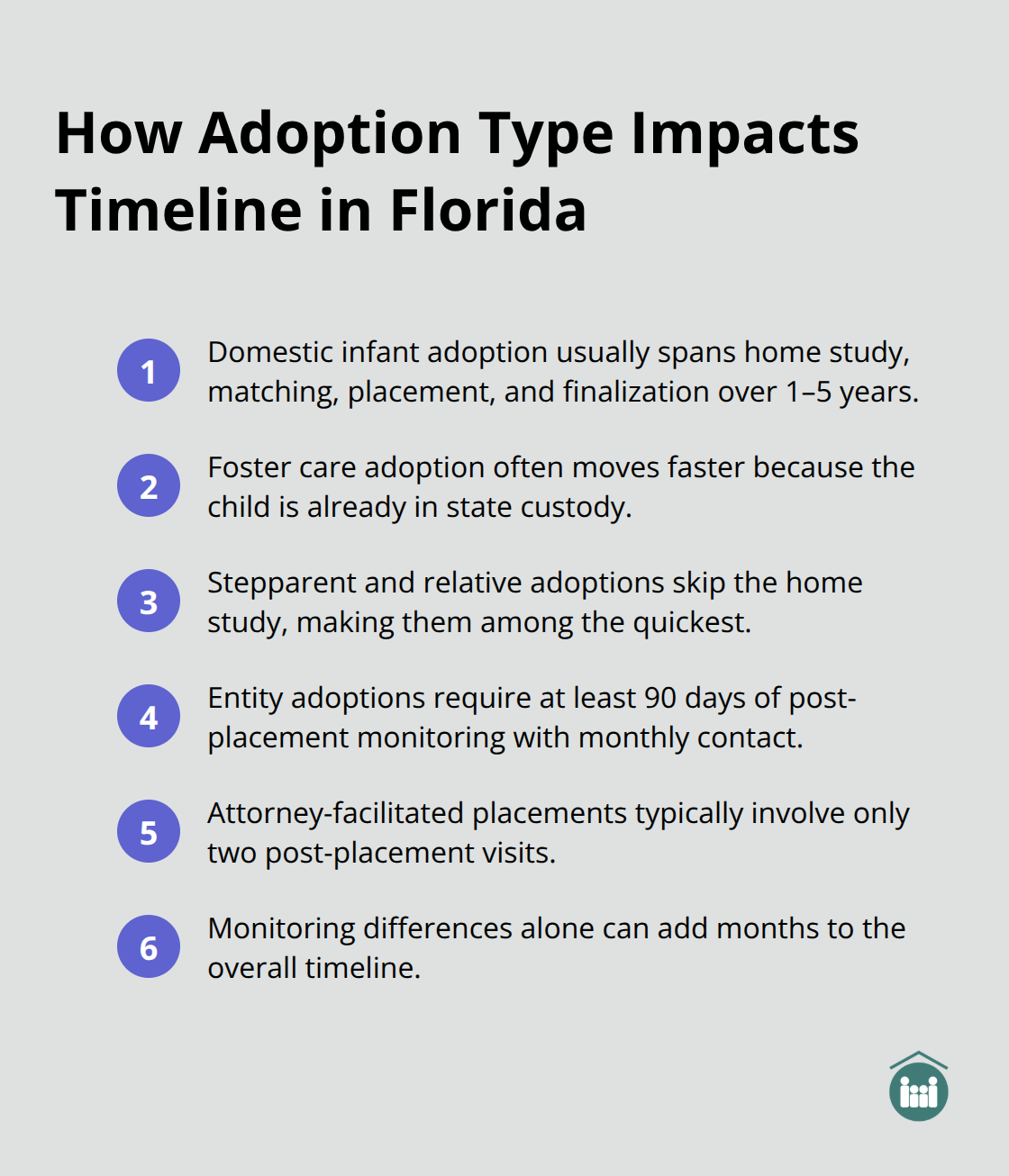
Florida law requires a minimum of 90 days of post-placement monitoring with mandatory monthly contact for entity adoptions, while attorney-facilitated placements typically need just two post-placement visits. This legal difference alone can add months to your timeline.
Legal Waiting Periods You Cannot Avoid
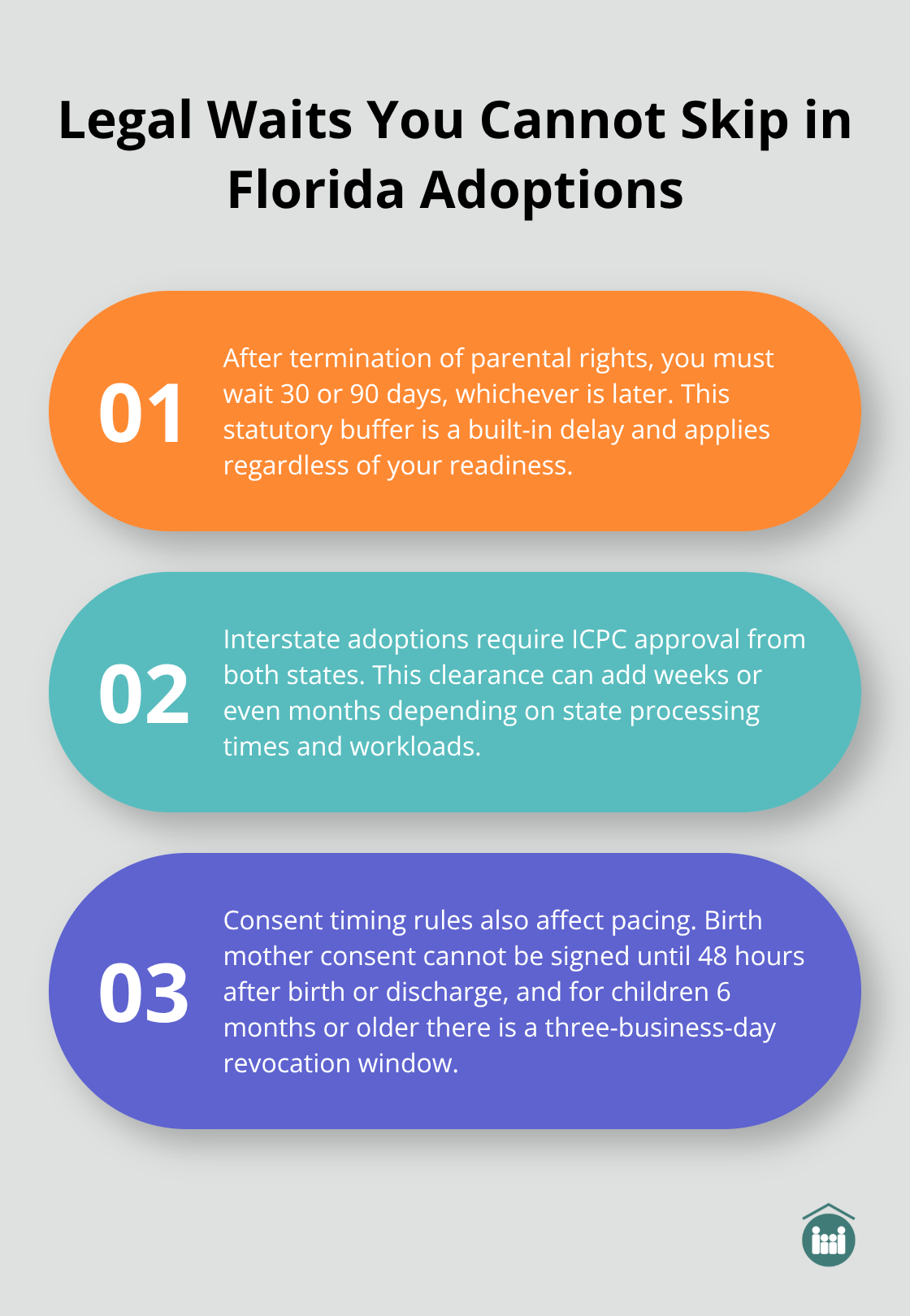
The 30 or 90-day waiting period after termination of parental rights-whichever comes later-is another built-in delay you cannot avoid. If a match happens with a birth mother outside Florida, you’ll need Interstate Compact on Placement of Children approval from both states before placement can occur, and this clearance can add weeks or even months depending on state processing times. Birth mother consent cannot be signed until 48 hours after birth or hospital discharge, and if the child is 6 months or older, Florida law grants a three-business-day revocation window that can delay finalization.
Documentation and Background Requirements
Background checks and documentation requirements either accelerate or stall your progress. Unmarried biological fathers must be registered with Florida’s Putative Father Registry, and if they haven’t registered, the agency must still provide notice of the adoption plan-this step introduces additional procedural time. Having all required documents prepared and current before you start prevents unnecessary slowdowns; many families lose months simply because they submit incomplete paperwork or fail to update information after major life changes.
Flexibility and Match Availability
The availability of suitable matches depends heavily on how flexible you are. Birth mothers aged 18 to 29 most commonly prefer LGBT or single-mother prospective parents, which means if you fit those categories, your wait may be shorter. Being open to children of any race and either gender significantly expands your pool of potential matches. National adoption agencies reach birth mothers across the entire country rather than limiting your options to your local community, which directly reduces wait times. Your willingness to consider different adoption opportunities directly influences how quickly you move toward placement.
Timeline for Domestic Adoption in Florida
Initial Consultation and Legal Preparation
The domestic adoption timeline breaks into three distinct phases, each with its own pace and requirements. Your first phase starts when you contact an adoption attorney or agency and runs through legal preparation, typically taking 2 to 3 months. During this window, you complete your home study, which investigates your family’s strengths, readiness to parent, and capacity to provide a loving home. The home study includes background checks and reference verification. You can speed this up significantly by pre-submitting all requested documents and finishing paperwork in advance rather than waiting for requests. Many families lose weeks simply because they submit information piecemeal instead of gathering everything upfront.
Once your home study receives approval, you move into active status and become eligible for matching. The second phase-matching and placement-is where timelines diverge most dramatically.
Matching and Placement: Where Timelines Vary Most
After you become an active adoptive family, the time to be matched by a birth mother can range from a relatively quick match to more than a year, depending on your circumstances. A strong, appealing adoptive family profile can significantly shorten this waiting period. National adoption agencies reach birth mothers across the entire country, which widens your pool far beyond your local community and reduces wait times. Building a clear life plan and being authentic in interviews with birth mothers improves connection and may influence the pace of a match.
Once matched and placement occurs, Florida law requires a minimum of 90 days of post-placement monitoring with mandatory monthly contact for entity adoptions, though attorney-facilitated placements typically involve just two post-placement visits. Your flexibility matters tremendously here. Being open to adopting a child of either gender and of any race substantially shortens wait time. Birth mothers aged 18 to 29 most commonly prefer LGBT or single-mother prospective parents, which means if you fit those categories, your wait may be shorter. Most expectant parents want some form of open or semi-open adoption, which tends to help reduce wait times.
Court Proceedings and Finalization
Your final phase involves court proceedings and finalization. After placement, you must file a petition to terminate parental rights within 60 days, and the adoption hearing is scheduled after required waiting periods. Finalization occurs at a court hearing where you must be present, and the judge issues a final judgment of adoption. The domestic adoption process typically ranges from 1 to 5 years, though with flexibility and preparedness, adopting within roughly a year is feasible.
Keeping Your Timeline on Track
The timeline depends heavily on how specific you are about the types of adoption opportunities you’re comfortable with. Keeping your home study and adoption documentation current prevents unnecessary slowdowns; update your home study promptly after major life changes (a new home or job, for example) to avoid delays. The review time by authorities for home studies and documents can be lengthy, so having everything ready helps move things along faster.
International adoption follows a completely different path, with additional layers of complexity that extend timelines considerably.
Timeline for International Adoption in Florida
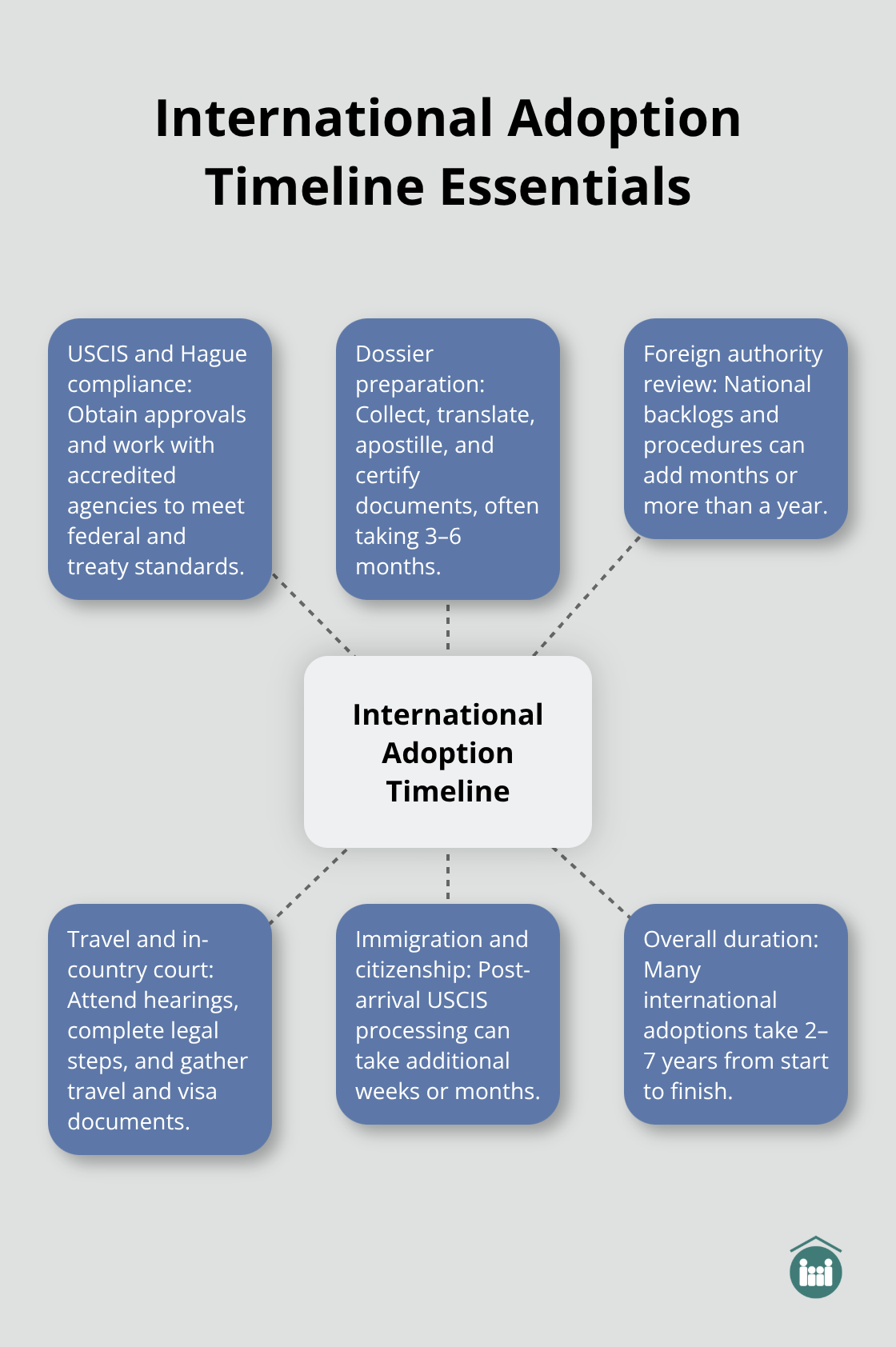
International adoption operates under federal law and the Hague Convention, which means your timeline extends far beyond what you experience with domestic adoption. The process requires approval from U.S. Citizenship and Immigration Services, coordination with a foreign country’s adoption authority, and compliance with that country’s specific legal requirements. Citizenship may be conferred when the foreign court proceedings occur or upon U.S. processing after the child arrives, but either way, you face substantially longer wait times than domestic adoption. Immigration and visa processing alone can stretch months or even years depending on the country you adopt from. Countries process adoption cases at their own pace, and some nations have backlogs that delay everything from initial application review to final court approval. You cannot rush a foreign government’s bureaucracy, and agencies cannot speed up processes controlled by another country’s judicial system. Before you commit to international adoption, contact an adoption attorney to understand the specific timeline for the country you’re considering, because wait times vary dramatically between nations.
Hague Convention Compliance Adds Procedural Steps
The Hague Convention requires accredited agencies to follow strict protocols that protect children and ensure ethical practices, but these safeguards add procedural steps and documentation requirements that extend your timeline considerably. Your agency must verify your home study meets Hague standards, submit your dossier to the foreign country’s central authority, and coordinate with licensed professionals in that country to identify a suitable match. This coordination happens slowly because multiple governments and agencies must review and approve each step. You’ll need apostilles on your documents, official translations, and verification from multiple agencies before your dossier is even complete. Many families underestimate how long the dossier preparation phase takes-often 3 to 6 months just to compile and certify all required paperwork. Once your dossier reaches the foreign country, processing timelines depend entirely on that nation’s current caseload and procedures. Some countries process cases within months; others take over a year.
You have no control over this waiting period, and agencies cannot guarantee timelines because they depend on foreign government action.
Travel and In-Country Court Proceedings
Once a match occurs in the foreign country, you typically must travel to that country to complete legal proceedings and bring your child home. This phase involves court hearings in the foreign jurisdiction, obtaining travel documents and visas for your child, and securing all necessary paperwork for international travel. Travel costs add thousands of dollars to your adoption expenses, and you may need to take extended time off work to complete the process in-country. After your child arrives in the United States, USCIS must process citizenship paperwork, which can take additional weeks or months depending on current processing times. The entire international adoption process commonly takes 2 to 7 years from start to finish, though some cases move faster if the country has efficient systems and your circumstances align favorably.
Final Thoughts
Adoption timelines in Florida range from one to five years for domestic adoption, though families who stay flexible with match preferences and maintain current documentation often complete the process within a year. International adoption takes considerably longer-typically two to seven years-because foreign government processing, Hague Convention compliance, and immigration requirements add substantial time to your case. Understanding how long the adoption process can take helps you set realistic expectations and plan your family’s future with confidence.
We at Juliana Gaita, P.A. help families navigate these timelines by providing clear legal guidance at every stage. Whether you pursue domestic adoption, consider international options, or pursue stepparent or relative adoption, proper legal representation prevents delays caused by incomplete paperwork, missed procedural requirements, or misunderstanding Florida’s specific regulations. Our team explains your rights and options, coordinates with agencies or birth mothers, manages court filings, and moves your case forward efficiently.
Contact Juliana Gaita, P.A. to discuss your adoption situation with an attorney who understands Florida law and can answer your specific questions. Whether you explore your options or move forward with a match, proper legal guidance makes the difference between a smooth process and unnecessary delays.