Stepparent adoption in Florida requires specific paperwork, and getting those forms right from the start saves time and prevents costly delays. We at Juliana Gaita, P.A. help families navigate this process, and we know that Florida stepparent adoption consent forms can be confusing without proper guidance.
This guide walks you through exactly where to find these forms, what information goes on each one, and how to complete them correctly so your petition moves forward smoothly.
What Makes a Florida Stepparent Adoption Different
A stepparent adoption in Florida is fundamentally different from other adoption types because it involves a child who already has one legal parent-the stepparent’s spouse. Under Florida law, the stepparent seeks to become the child’s second legal parent, which means the biological parent whose rights will be terminated must either consent or have that consent waived by a court. This distinction matters enormously because it streamlines the process compared to standard adoptions. The child doesn’t need to be placed through an adoption agency, and the stepparent doesn’t need to meet the same residency requirements as unrelated adoptive parents. However, Florida courts take parental rights seriously, and the biological parent’s involvement cannot be bypassed without proper legal grounds.
When Courts Waive Consent
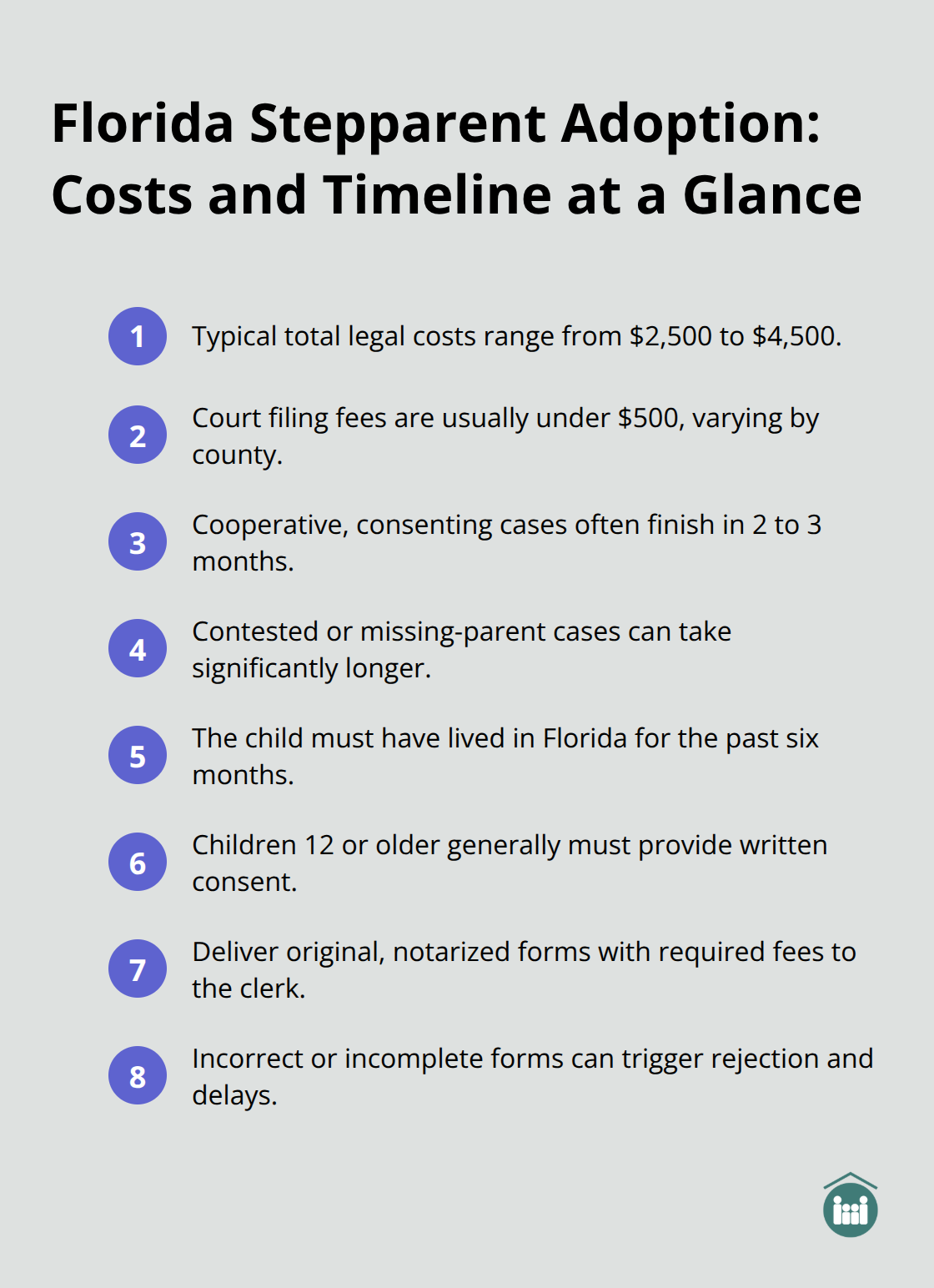
The most common reasons courts waive consent include abandonment, where a parent has failed to communicate or provide support for an extended period, or if the parent’s rights were previously terminated in another case. This is where many stepparent adoptions encounter problems-families often underestimate the complexity of proving abandonment or locating a non-custodial parent for consent. The timeline for a stepparent adoption typically runs 2 to 3 months if all parties cooperate and provide written consent willingly, but cases involving contested consent or missing parents can stretch significantly longer.
Who Can File the Petition
Florida law permits a stepparent to file a joint petition together with their spouse, who is the child’s biological or adoptive parent. The stepparent does not need to have lived in Florida for any set period, but the minor child must have resided in Florida for at least 6 months before the petition is filed. The filing happens in the circuit court located in the county where you reside, and the petition must be filed as a joint petition by both the stepparent and their spouse.
Age Requirements and Child Consent
If the child is 12 years old or older, the child’s own written consent is also required unless the court waives it for good cause. This age requirement is critical and frequently overlooked-a teenager’s refusal to consent can halt an otherwise straightforward adoption.
Understanding the Costs
The filing fee for a stepparent adoption ranges from $2,500 to $4,500 in total costs when working with an attorney, though this covers not just the filing fee itself but also legal preparation, document review, and court appearances. The actual court filing fee varies by county but is typically under $500. Do-it-yourself forms exist online, but they frequently miss statutory requirements or procedural details that delay cases or result in rejection by the court clerk.
Getting the consent forms right from the start prevents these costly rejections and keeps your adoption moving forward.
Where to Find the Forms You Actually Need
Florida Courts Don’t Maintain a Central Form Repository
Florida courts do not maintain a centralized online repository for stepparent adoption consent forms, which creates confusion for families trying to handle this process independently. The Office of the State Courts Administrator, located at 500 South Duval Street in Tallahassee, supports statewide court operations but does not distribute adoption forms directly to the public. Instead, you obtain forms through your local circuit court clerk’s office in the county where you plan to file your petition.
Contact Your County Circuit Court Clerk
Each county clerk maintains its own adoption forms, and these vary slightly depending on local court procedures. Contact your circuit court clerk by phone or visit their office in person to request the Petition for Stepparent Adoption, Consent and Waiver of Notice form, UCCJEA Affidavit, and Indian Child Welfare Act Affidavit. The clerk’s office provides these forms at no cost or directs you to download them from the county’s website.

Many counties now offer downloadable forms through their websites, so checking your specific county clerk’s website first saves a trip to the courthouse. When you call, ask specifically for stepparent adoption forms and mention that you need all required documents for an uncontested case where the biological parent is consenting.
The Consent and Waiver of Notice Form
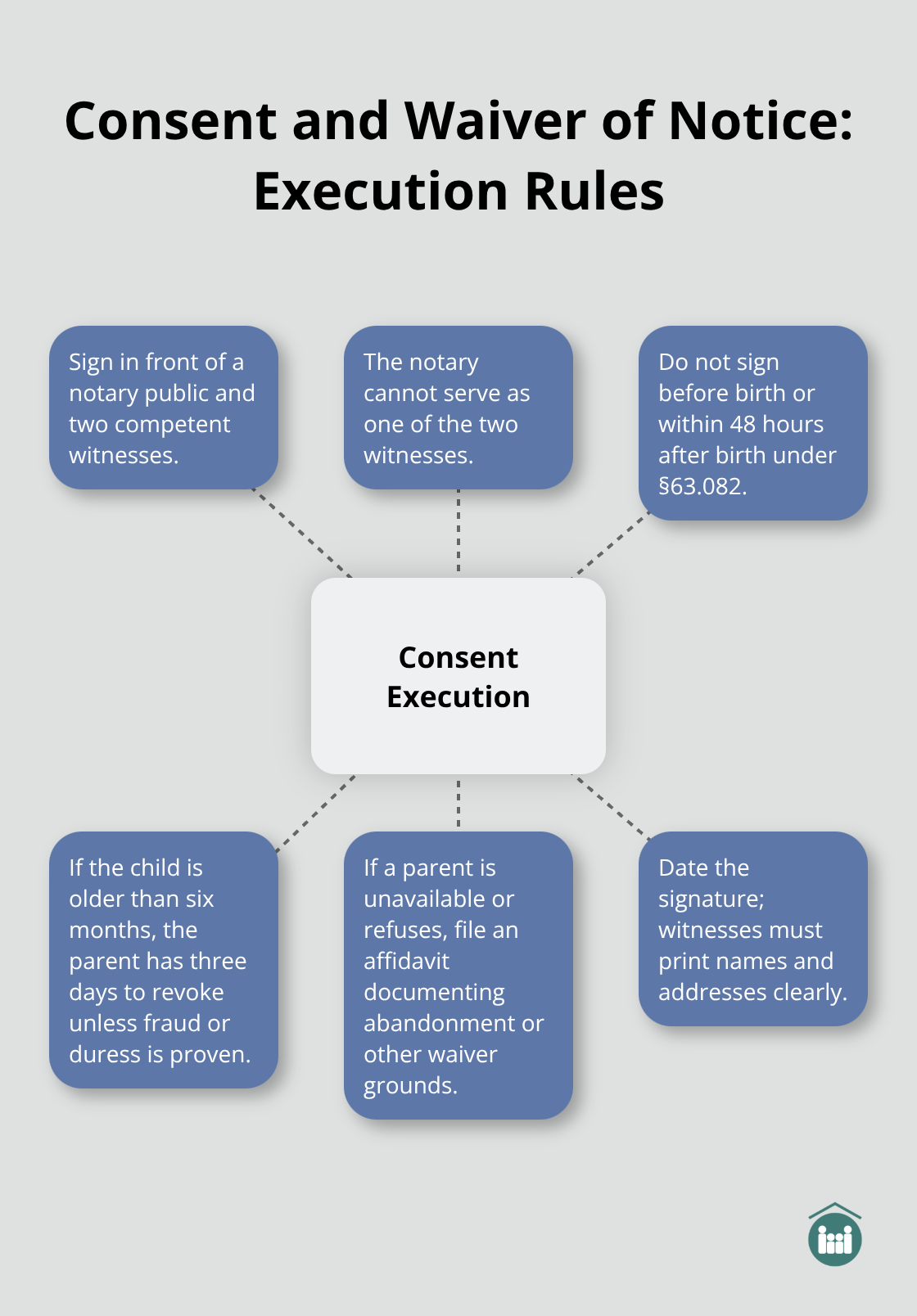
The Consent and Waiver of Notice form stands as the critical document because it formally terminates the biological parent’s rights and confirms their agreement to the adoption. This form must be executed in front of a notary public with two witnesses present, and the biological parent cannot sign it before the child’s birth or within 48 hours of birth under Florida Statute §63.082. If the biological parent is unavailable or refuses to sign, you will need an affidavit documenting abandonment or other grounds for waiver, which requires different forms and often court intervention.
Why Generic Forms Fail in Florida Courts
Do not attempt to use generic adoption forms from online template services because Florida courts reject documents that do not match statutory requirements for stepparent adoptions. The UCCJEA Affidavit confirms that Florida has proper jurisdiction over the child, and the Indian Child Welfare Act Affidavit ensures compliance with federal law if the child has Native American heritage. If the biological father’s paternity has not been established, you need an additional affidavit stating his identity and the efforts made to locate him.
Getting the Right Forms Prevents Costly Delays
Obtaining these specific forms from your county clerk ensures they meet current Florida statutory requirements and local court preferences. Courts reject documents that deviate from statutory language, and rejections delay your case significantly. Once you have the correct forms in hand, the next step involves understanding what information each document requires and how to complete them accurately-details that separate successful petitions from those that stall in the clerk’s office.
Filling Out Forms Correctly the First Time
Required Information on the Petition
The Petition for Stepparent Adoption demands specific information that courts will not overlook, and missing even one required field triggers a rejection from the clerk’s office. You must include the child’s full legal name as it appears on the birth certificate, the child’s date and place of birth, the desired new legal name if you plan to change it, and how long the stepparent has lived with the child in the household. Florida courts also require you to list both the stepparent and their spouse as joint petitioners in the caption, along with the biological parent whose rights will be terminated. Many families make the critical mistake of listing only the stepparent as the petitioner, which causes immediate rejection. You must state the specific reasons you are seeking adoption in the petition itself.
Jurisdiction and Paternity Affidavits
The UCCJEA Affidavit confirms that the child has lived in Florida for at least the past six months and that no other custody orders exist in different states or counties. If the biological father’s paternity has not been established through marriage or a signed acknowledgment filed with the Florida Office of Vital Statistics, you need a separate affidavit identifying him by name and describing the specific efforts made to locate him for service. This affidavit protects your case by documenting that you took reasonable steps to notify the biological father, which satisfies Florida’s due process requirements.
Execution Requirements for Consent Forms
The Consent and Waiver of Notice form is where most families encounter problems because it demands precise execution requirements that cannot be skipped or modified. The biological parent must sign this form in front of a notary public and two competent witnesses, and the notary cannot serve as one of the two witnesses. Florida Statute §63.082 prohibits any biological parent from signing consent within 48 hours of the child’s birth, and if the child is older than six months at the time of signing, the biological parent has three days to revoke the consent unless fraud or duress is proven. The signature must be dated, and the witnesses must print their names and addresses clearly on the form.
Methods That Florida Courts Reject
Do not attempt to have the biological parent sign via electronic signature, fax, or email because Florida courts reject these methods for adoption consent. If the biological father cannot be located despite documented efforts, you file an affidavit of efforts to locate him, and the court may waive his consent requirement under Florida Statute §63.064. The Indian Child Welfare Act Affidavit requires you to certify whether the child has Native American heritage or tribal membership, and if you cannot determine this with certainty, you must state that in the affidavit rather than guessing.
Filing Your Completed Forms
Once all forms are completed with signatures properly witnessed and notarized, you deliver the originals to your county circuit court clerk along with the filing fee, which varies by county but typically runs between $300 and $500 for the adoption action itself. The clerk’s office reviews each document for compliance with statutory requirements before accepting your petition for filing.
Final Thoughts
Getting Florida stepparent adoption consent forms right from the start determines whether your petition moves forward smoothly or gets rejected by the court clerk. The forms themselves are straightforward once you know where to find them and what information each one requires, but the execution details matter enormously. Your county circuit court clerk provides these forms at no cost, and most counties now offer them online, which saves time compared to visiting the courthouse in person.
The Consent and Waiver of Notice form stands as the critical document because it formally terminates parental rights, and it must be signed in front of a notary and two witnesses with no exceptions. The UCCJEA and Indian Child Welfare Act affidavits protect your case by confirming jurisdiction and compliance with federal law. Missing even one required field or using incorrect execution methods triggers rejection, which delays your adoption by weeks or months.
If you face contested consent, cannot locate the biological parent, or need to prove abandonment, the complexity increases significantly. Contact Juliana Gaita, P.A. to discuss your adoption case with someone who understands Florida law and can review your documents before filing to catch errors that would otherwise result in rejection.