
Adoption timelines vary significantly depending on the type of adoption you’re pursuing and where you live. In Florida, the process can take anywhere from several months to over a year, influenced by documentation requirements, background checks, and court schedules.
Understanding how long the adoption process takes helps you prepare mentally and financially for this journey. We at Juliana Gaita, P.A. break down the realistic timelines for domestic, stepparent, and foster-to-adopt cases specific to Florida law.
What Slows Down or Speeds Up Your Adoption Timeline
The Adoption Type You Choose Controls Your Speed
Your adoption timeline depends far less on luck and far more on how you navigate three specific factors. The type of adoption you choose, Florida’s regulatory requirements, and your preparation level determine whether you finish in four months or stretch beyond a year.
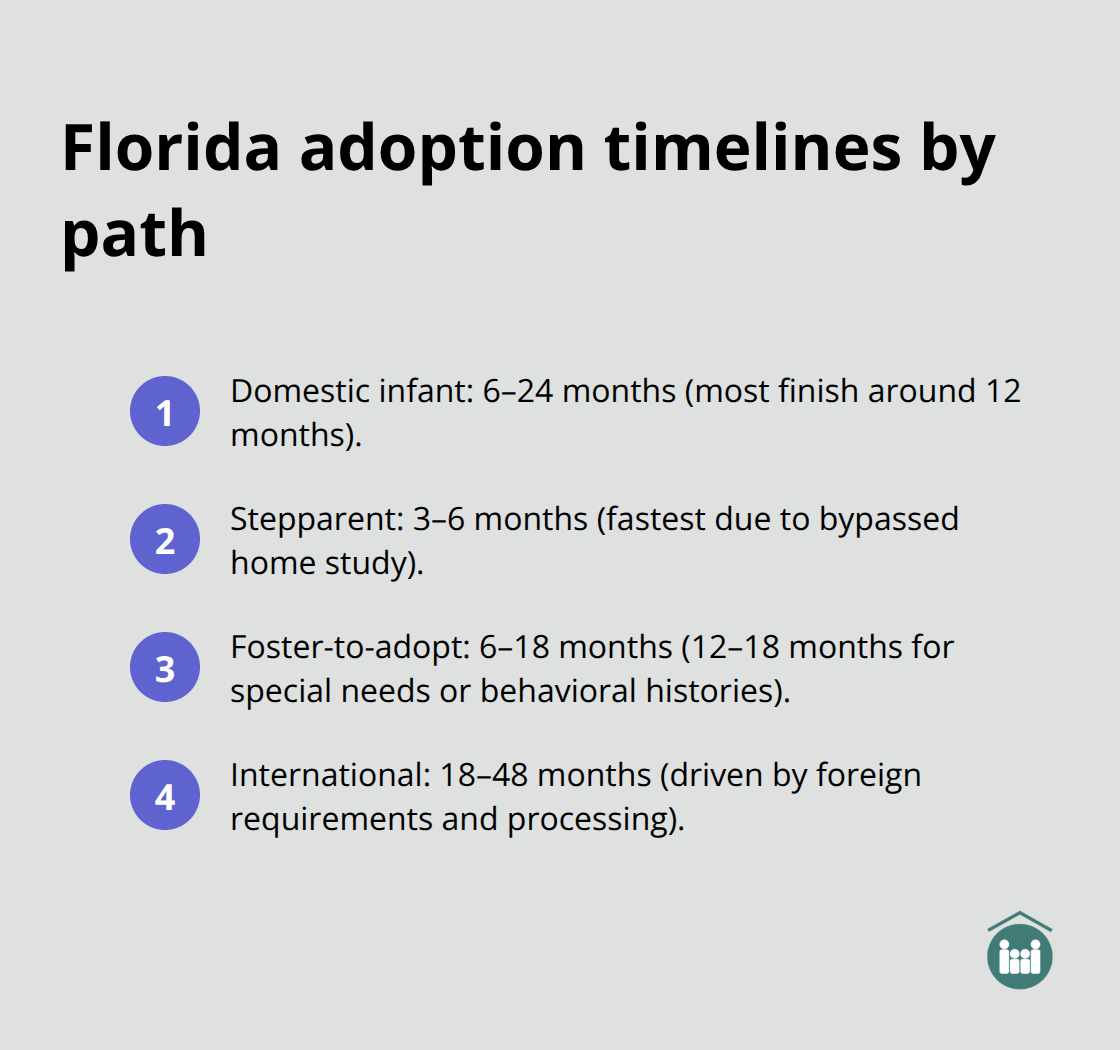
Domestic infant adoption typically takes 6–24 months, while stepparent adoption moves fastest at 3–6 months because it bypasses the full home study requirement. Foster-to-adopt timelines range from 6–18 months, though children with special needs or behavioral histories often extend this to 12–18 months. International adoption sits on the opposite end at 18–48 months due to foreign country requirements and processing delays. Your choice here isn’t just about preference-it directly controls your timeline. If speed matters, stepparent adoption moves substantially faster. If you want an infant, prepare for the longest wait.
If you’re open to foster care, the state covers many costs and accelerates the process compared to private domestic infant adoption.
Florida’s Requirements Create Predictable Delays
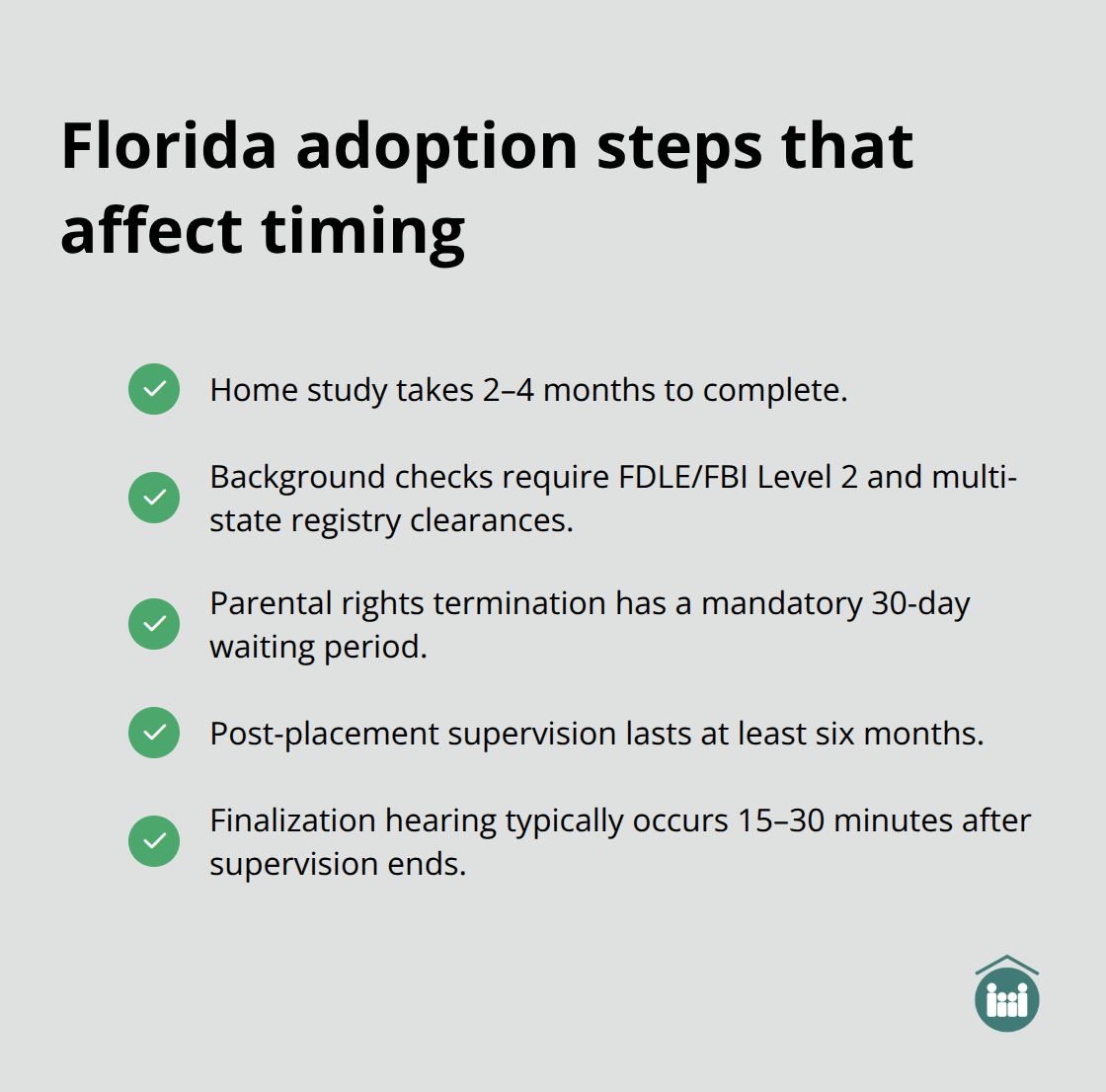
Florida’s specific requirements create predictable delays if you’re not prepared. The home study takes 2–4 months and includes a home safety inspection, personal interviews, reference checks, financial review, and medical statements. Background checks require Level 2 screening through FDLE and the FBI, child abuse and neglect registry checks for every state you’ve lived in during the past five years, and sexual predator registry checks for all household adults. The termination of parental rights involves a mandatory 30-day waiting period after consent. Post-placement supervision lasts at least six months with monthly visits. Finalization hearings typically occur 15–30 minutes after this period ends.
None of these steps are optional, and none compress easily.
What You Control: Preparation and Documentation
What you control is preparation. You should gather documents early, complete your home study before you’re matched, and maintain current background checks to prevent unnecessary delays. Many families lose three to six months simply because they scramble to finish paperwork after receiving a match opportunity. The families who finish fastest submit everything before they actively search for a match.
Documentation completeness matters more than any other single factor. Courts won’t schedule finalization hearings until all required documents are verified and approved. One missing reference letter, an outdated medical statement, or incomplete financial disclosure forces restarts and delays court dates by weeks or months. An adoption attorney can provide a complete checklist specific to your situation, which ensures nothing falls through the cracks. With your documents ready and your home study complete before you start your search, you position yourself to move forward the moment a match opportunity appears-rather than scramble to catch up after one does.
Timelines for Each Adoption Path
Domestic Infant Adoption: Speed Depends on Your Flexibility
Domestic infant adoption in Florida takes 6–24 months, with most families completing the process in 12 months according to American Adoptions data. The variability stems from how quickly you match with an expectant mother and how specific your preferences are. Families willing to adopt across racial lines and remain flexible on gender match within 3–6 months. Those seeking a healthy white infant often wait 12–24 months because fewer birth mothers match that profile. The home study takes 2–4 months upfront, matching occurs during active search (3–12 months depending on flexibility), and finalization happens 6 months after placement. Court scheduling varies by county; some finalize within 30 days of the six-month post-placement window, while others add another 4–8 weeks.
Flexibility accelerates your timeline more than any other factor. Families who specify only healthy white infants wait longer than those open to transracial adoption or children with minor medical needs. Your willingness to pursue semi-open or open adoptions with the birth family also shortens wait times because birth mothers actively choose adoptive families who support ongoing contact.
Stepparent Adoption: The Fastest Route
Stepparent adoption moves fastest at 3–6 months because Florida bypasses the full home study requirement in these cases. You complete background checks and provide financial documentation, but the process skips the extensive home inspection and multi-month home study timeline. Court fees run 300–500, attorney fees typically 1,500–3,000, and you file directly in your home county circuit court. This path offers the shortest timeline of all adoption types in Florida.
Foster-to-Adopt: Lower Costs, Longer Commitment
Foster-to-adopt timelines range from 6–18 months, though realistic expectations depend on the child’s age and history. Infants in foster care finish closer to 6–12 months, while children over age 13 often extend to 18 months or longer because they may require additional trauma-informed parenting training and behavioral assessments before placement. The state covers most costs (including home study fees and finalization legal fees), which removes the 15,000–50,000 expense barrier of private domestic infant adoption. You complete MAPP training instead of standard pre-adoption education, obtain foster licensing, and attend monthly post-placement visits. Many families overlook that foster care offers the fastest path to parenthood when you remain open to children with behavioral or emotional needs and ages beyond newborns.
Understanding these timelines helps you choose the adoption path that aligns with your family’s circumstances and preferences. Each route presents distinct advantages-speed, cost, or flexibility-that shape your overall experience. The next section shows you how to accelerate whichever path you select.
Speed Up Your Adoption by Preparing Your Paperwork First
Complete Your Home Study Before You Search
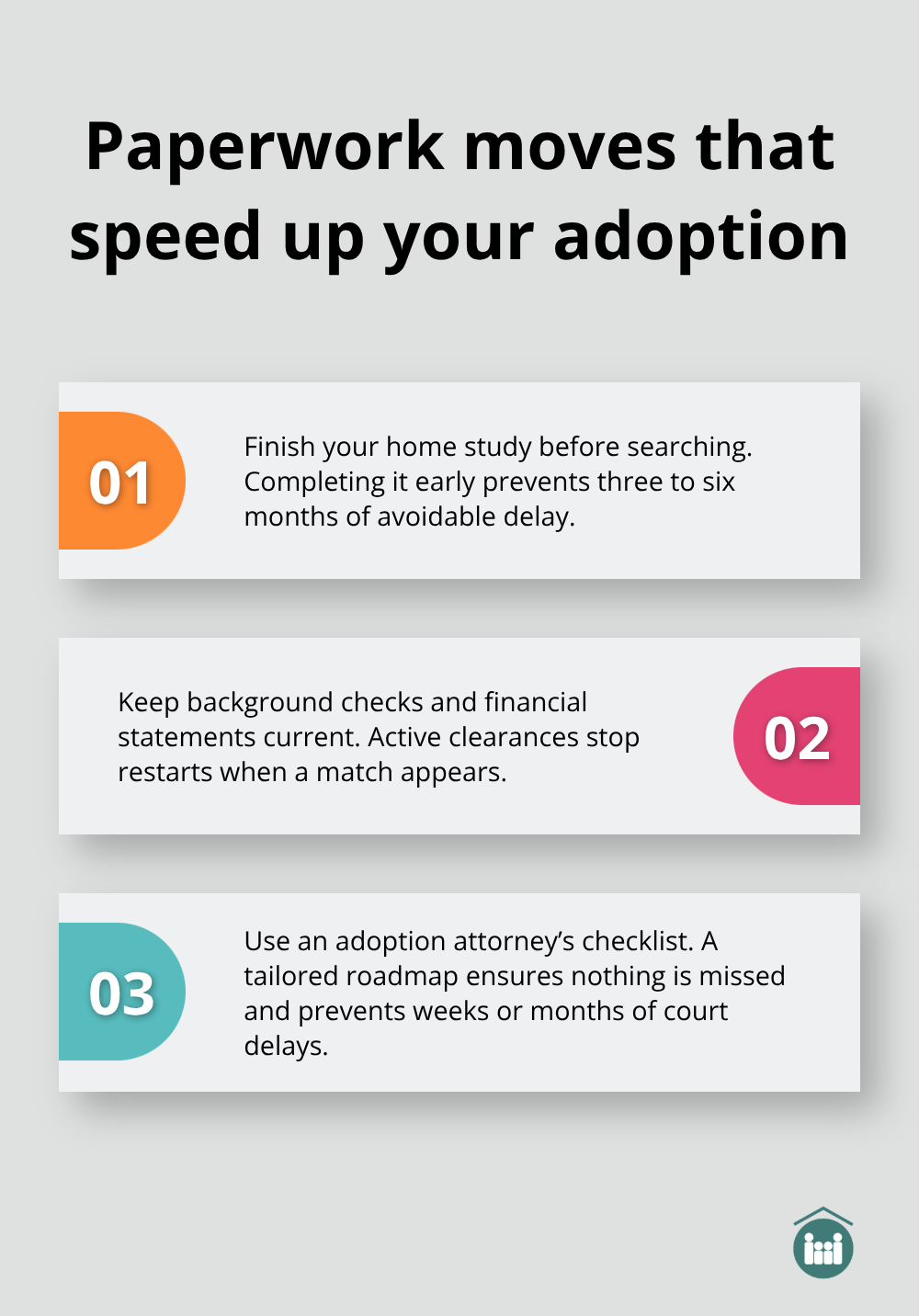
The single biggest mistake families make is waiting until they match with a birth mother or child before completing their home study and gathering documents. This backward approach costs three to six months of unnecessary delay. Instead, finish your home study before you actively search. Gather every required document upfront. Have your background checks completed and your financial statements prepared.
The families who move fastest treat documentation as the first step, not the last one.
An adoption attorney provides a complete checklist specific to your situation-whether you’re pursuing domestic infant, stepparent, or foster-to-adopt. Nothing gets missed when you have this roadmap before you begin your search. The cost of an attorney’s consultation is minimal compared to the three-month delays that a missing reference letter or outdated medical statement can trigger.
Understand How Courts Control Your Timeline
Florida courts won’t schedule finalization hearings until all required documents are verified and approved. One incomplete form forces a restart. Courts move on their own timeline, and you can’t compress that timeline, but you absolutely can avoid self-imposed delays through early preparation. Families who submit everything before matching move to finalization within the standard timeframe. Families who scramble after matching face court delays of four to eight weeks simply because judges won’t proceed until paperwork is complete.
Make Flexibility Your Matching Accelerator
Your flexibility on child characteristics directly controls your matching speed, and this decision should drive your entire preparation strategy. Families willing to adopt across racial lines and remain open on gender match within three to six months according to American Adoptions data. Those seeking a healthy white infant often wait twelve to twenty-four months because fewer birth mothers match that specific profile. This isn’t a judgment-it’s a statistical reality.
If speed matters to your family, your preferences should reflect that priority. The same principle applies to foster-to-adopt: children over age thirteen experience longer waits than younger children, but if you’re willing to parent a teenager, you access a pool of children where demand is lower and placement happens faster.
Open Adoption Reduces Your Wait Time
Your willingness to engage in semi-open or open adoptions with birth families shortens wait times significantly because birth mothers actively choose adoptive families who support ongoing contact. These aren’t minor preferences-they’re the levers that determine whether you finish in four months or eighteen months. Before you invest time and money in your home study, decide what flexibility means for your family and communicate that clearly to your attorney.
Final Thoughts
Adoption timelines in Florida range from three months for stepparent cases to eighteen months or longer for domestic infant and foster-to-adopt paths. Your timeline depends on the adoption type you choose, how thoroughly you prepare your documentation, and how flexible you remain on child characteristics. Families who complete their home study and gather documents before matching move substantially faster than those who scramble after a match opportunity appears.
The question of how long the adoption process takes ultimately comes down to decisions you make before you file paperwork. Stepparent adoption moves fastest because it bypasses extensive home study requirements, while domestic infant adoption takes longer because matching depends on birth mother preferences and your specificity about child characteristics. Foster-to-adopt offers lower costs and faster placement when you remain willing to parent children with behavioral or emotional needs.
Contact Juliana Gaita, P.A. to discuss your rights and options with our legal team. An attorney reviews your situation early, provides you with a complete checklist specific to your adoption type, and coordinates with background check providers, home study agencies, and the court system so you avoid delays caused by miscommunication or incomplete submissions. The sooner you begin with proper guidance, the sooner you move toward your family’s next chapter.